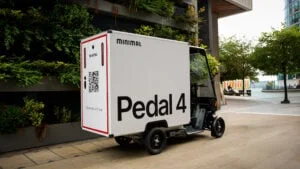
Used by Royal Mail and Evri, Pedal 4 carries 2.5 cubic metres of cargo and can access London streets that vans struggle to reach.
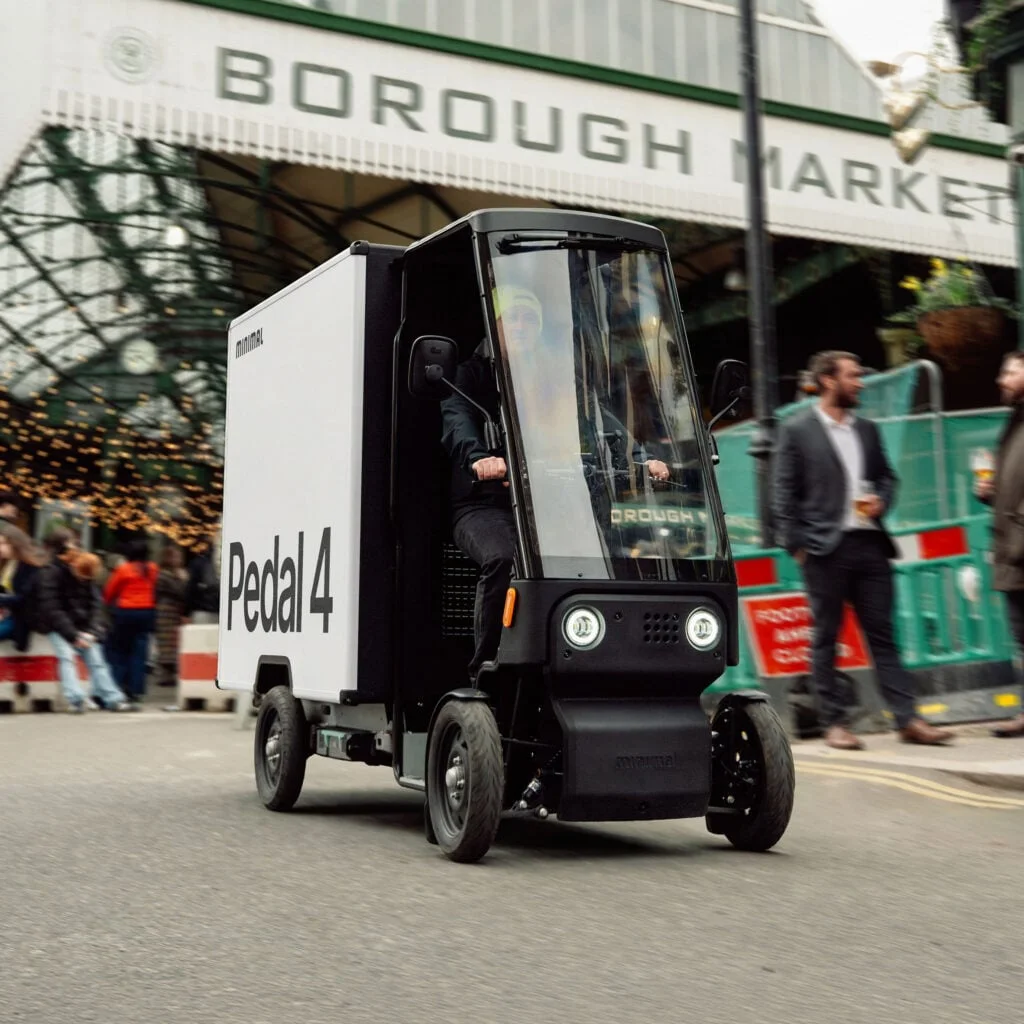
Pedal 4’s pitch is simple: carry a van-sized delivery load while moving through London like a bicycle. That could matter more than another electric van, because emissions are only part of the urban delivery problem. Access, congestion and kerb space remain obstacles.
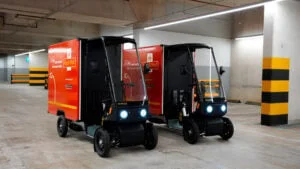
Designed by British start-up Minimal, the four-wheeled, pedal-assist vehicle is now being used in London by Royal Mail and Evri. It has also been shortlisted in the consumer product design category of the 2026 Dezeen Awards.
A compact vehicle with a large delivery role
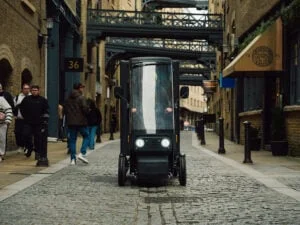
At three metres long and one metre wide, Pedal 4 takes up little more road space than a bike, according to Minimal. Its dimensions are intended to let it use cycle infrastructure and pedestrianised streets, helping it reach routes that a van may struggle to enter. The company describes its cargo capacity as comparable to that of a small van.
The numbers are striking: the cargo box holds 2.5 cubic metres, and during London trials the vehicle completed 36 per cent more deliveries per hour than vans. That’s a meaningful result, though the available figures don’t explain the trial conditions or how broadly they apply.
“Electric vans solve the emissions problem, but not the access problem,” said Minimal CEO and co-founder Patrick Bion. “They still sit in the same traffic, fight for the same kerb space and need a driver with a licence.”
“They weren’t built for the job they’re doing,” he added. “We designed Pedal 4 around that job: a full round of deliveries, through streets a van can’t get down, ridden by anyone who can ride a bike.”
Built around the work
Minimal presents Pedal 4 as a purpose-built delivery vehicle, rather than a van with an electric drivetrain or a bicycle enlarged to carry more. Its appearance follows that practical brief: the cargo body sits on a narrow, four-wheeled base, with a pedal-powered riding position at the front.
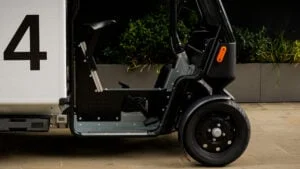
That four-wheel layout also shapes how it handles a load. Independent double-wishbone suspension at the front and a rubber torsion axle at the rear are designed to keep the vehicle level through corners, including when the cargo box is full. Whether the design delivers the same efficiency across different routes and loads remains to be seen, but its central argument is clear: urban delivery vehicles need to fit the streets they serve.
Pedal 4’s strongest design choice may be what it leaves out. Minimal removed the conventional bike chain, cut fasteners and reduced the number of parts to make the delivery vehicle easier to repair and cheaper to build. Its exposed zinc-coated carbon-steel frame and satin-black metal covers let that practical structure define the look.
“Pedal 4 has to do a van’s job every day for years, so it can’t be fragile, fussy or expensive,” said Minimal product design engineer Sean Heany. He said the biggest gains came from deleting parts rather than adding features. Rethinking the geometry also reduced fastenings, making the vehicle tougher, faster to fix and less costly to produce in the company’s London microfactory.
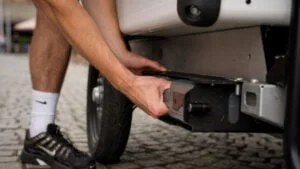
Two removable batteries sit in slots on the vehicle. Together they provide a 60-kilometre range, and either can be taken out for charging. In the UK, Pedal 4 is classed as a heavy-duty electrically power-assisted cycle, or EPAC, so it can be driven without a licence. That opens the role to a wider pool of delivery workers.
Data for a mixed fleet
Minimal sees autonomous vehicles working alongside human-driven ones in future logistics. Each Pedal 4 runs the company’s FleetOS software, which tracks routes and vehicle performance. The accumulated data is intended to guide future design changes and support Minimal’s autonomous vehicle programme.
Minimal has also launched Bot, a delivery robot aimed at the UK and EU markets. Heaney described Pedal 4 as the starting point for the company’s autonomy work, citing more than 100,000 kilometres of delivery data gathered by its connected vehicles. The commercial test is whether the same principles—fewer parts, lower costs and high uptime—can make autonomous delivery work economically as well as technically.
Pedal 4 has been developed, tested and launched on London streets with Royal Mail and Evri. Heaney says the vehicles and software can scale across Europe, with a US launch planned for 2027. London is a demanding proving ground, though success there alone won’t establish how the system performs in every city.
Heaney argues that cities need new ways to move goods, with benefits for urban life and the environment. The more immediate point is that delivery vehicles must keep working day after day; Pedal 4’s stripped-back construction is designed around that requirement. Other recent electric vehicle concepts for urban travel include the doorless, golf-cart-style Amble One and the three-wheeled Trinity.
Discussion
Sign in to join the discussion.