At OPTECH 2026 in Las Vegas, two major apartment firms outlined where they’re adopting AI, building tools and keeping people central to resident service.
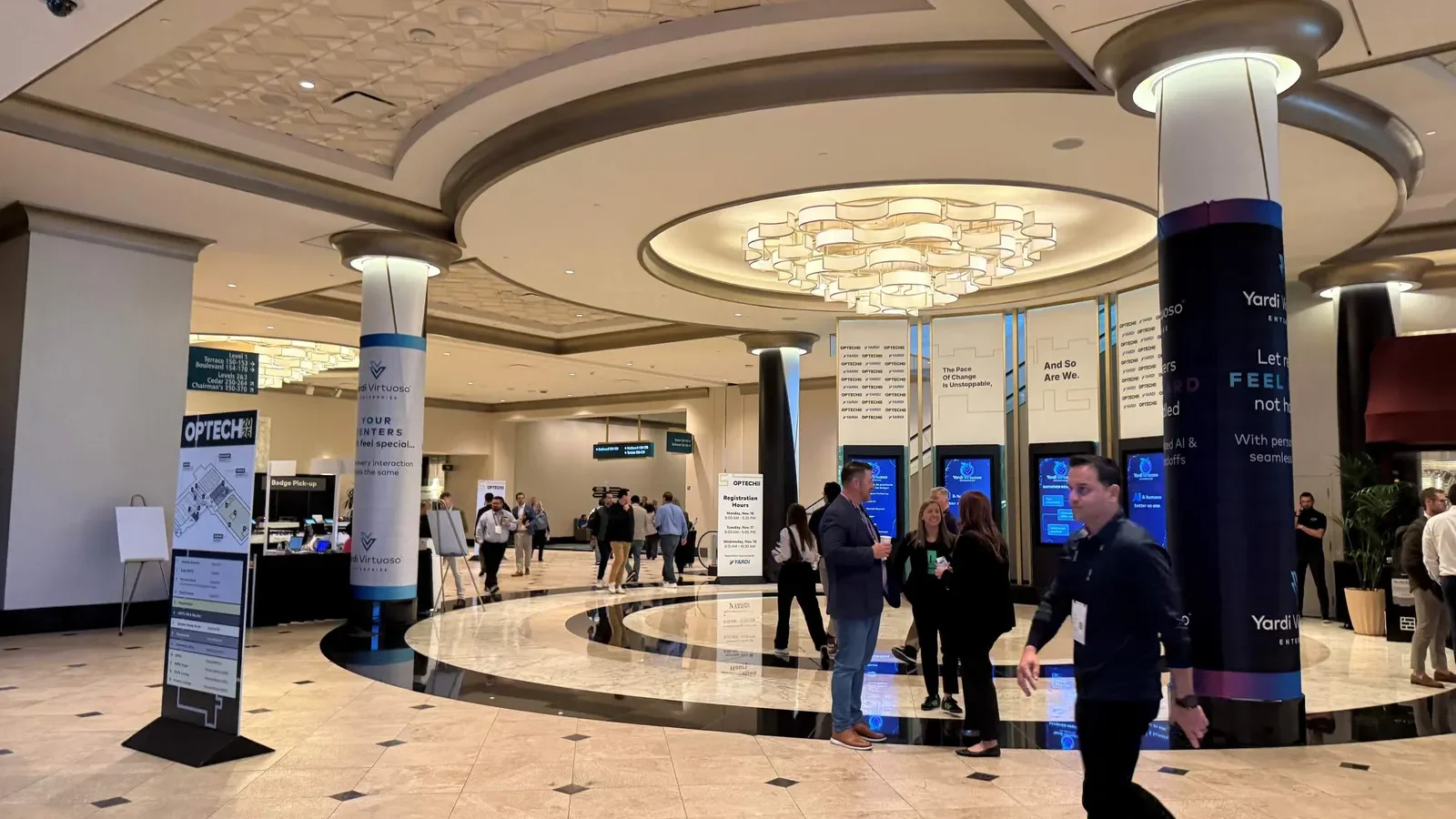
For multifamily operators, the emerging AI question is less about what the technology can do than where it can make a meaningful difference. At OPTECH 2026 in Las Vegas, leaders from Morgan Properties and Willow Bridge Property Co. described strategies that pair off-the-shelf software with selective custom development and human judgment. Their comments point to a practical shift in the discussion: the goal isn’t to add AI wherever it fits, but to identify work where it can improve a process or resident experience without creating new problems for staff.
The distinction matters as apartment firms weigh whether to build internal systems or buy from vendors. Morgan Properties ranks No. 2 among owners on the National Multifamily Housing Council’s 2026 Top 50, while Willow Bridge ranks No. 3 among managers. Those positions give the companies a broad operating context, but they don’t make any one AI approach automatically transferable to another firm. Their strategies instead point to a shared priority: direct development toward workflows or resident experiences that can set a company apart.
Willow Bridge encourages teams to test and share ideas
Willow Bridge’s approach has three parts: adopt tools already available, work with partners to rethink workflows, and give employees room to experiment. Chief Operating Officer Jennifer Staciokas said staff are encouraged to use Microsoft Copilot and, in some cases, Claude to explore ideas and build early solutions. That structure gives employees a way to test practical uses before the company decides whether an idea merits broader investment.
Since rejoining the company three months before the conference, Staciokas had seen employees bring forward several potential applications. The next step is to assess whether those ideas can scale across the organization. A useful pilot has to do more than work for one person or team; it needs a clear purpose, a workable process and a result that others can assess. One department has already worked with IT to develop products for internal users, an effort she said the company plans to expand.
That experimentation comes with a need to teach teams how to check AI output. When staff find an error or discrepancy, Staciokas said managers should explain what raised the concern and how they reached their judgment. Sharing that context helps colleagues learn to assess future results themselves, rather than treating an answer from a tool as reliable simply because it sounds polished. The approach also makes review part of everyday work instead of leaving quality control to a small group of specialists.
Her point aligns with a broader operating principle offered by Cardinal Group Cos. Chief People Officer Peter Lynch at the conference: AI can handle repeatable work, while people should focus on tasks that call for a remarkable result. The division sounds clear, but applying it can take judgment. Some routine tasks carry consequences for residents or employees, and an automated first draft may still need close review. For operators, the practical question is where that distinction matters most in daily work.
Morgan Properties focuses custom development on differentiation
Morgan Properties places technology staff within other departments so they can spot needs as they arise and evaluate tools for customer experience, automation and productivity, said Devang Patel, the company’s head of technology. That arrangement can keep technology decisions connected to the work employees actually do. It also gives the company a way to compare a proposed tool with existing processes before committing to a larger change.
Patel sees little reason for apartment firms to build common systems such as customer relationship management, accounting or human resources platforms when established products are available. His advice is to select a platform that fits the company’s strategy and put it to work. That’s a restrained view of in-house development: building software takes time and attention, so a company needs a clear reason to take on that work when vendors already offer standard capabilities.
Custom development makes more sense when standard offerings look alike and a company can create a distinctive experience or capability. Patel’s test is straightforward: if competing products appear similar, that may signal an opportunity to build something that differentiates the organization. The test doesn’t guarantee that a custom tool will succeed; it focuses attention on whether the resulting capability would give the company something meaningfully different to offer.
Here’s the thing: the decision to buy or build is only the start. A tool has to fit the workflow, and employees need to know where its output can be trusted and where it needs review. If you’re working in this space, the most useful early question may be less “Can AI do this?” and more “What changes for staff or residents if it does?” A clear answer makes it easier to judge whether a proposed application deserves a pilot and, later, broader use.
Human judgment remains part of the operating model
AI can improve efficiency, but Patel cautioned against expecting it to solve every operational challenge. Resident relationships still depend on people, especially in moments that matter. A system may help with repeatable steps, but the quality of service still depends on how a team handles the exchange when a resident needs attention or a situation calls for judgment.
This is more significant than it looks. The firms’ comments suggest that adopting AI isn’t a single technology decision; it’s also a question of how work gets reviewed, who can identify a mistake and whether useful experiments can move beyond one department. (And this is the part most people overlook.) A promising demonstration doesn’t establish that a process is ready to scale across different teams and situations.
There’s no shortcut around that assessment. Willow Bridge is emphasizing experimentation and shared learning, while Morgan Properties is tying technology staff to departmental needs and reserving custom development for areas of potential differentiation. For both firms, the next phase will turn on choosing the right places to automate while keeping teams equipped to judge the work and deliver personal service. The test will be whether those choices improve operations in practice, not simply whether a new tool can produce an answer.
Discussion
Sign in to join the discussion.