New York’s November design calendar is taking shape, with collectible showcases, BDNY commerce and satellite exhibitions pointing to a distinct fall draw.
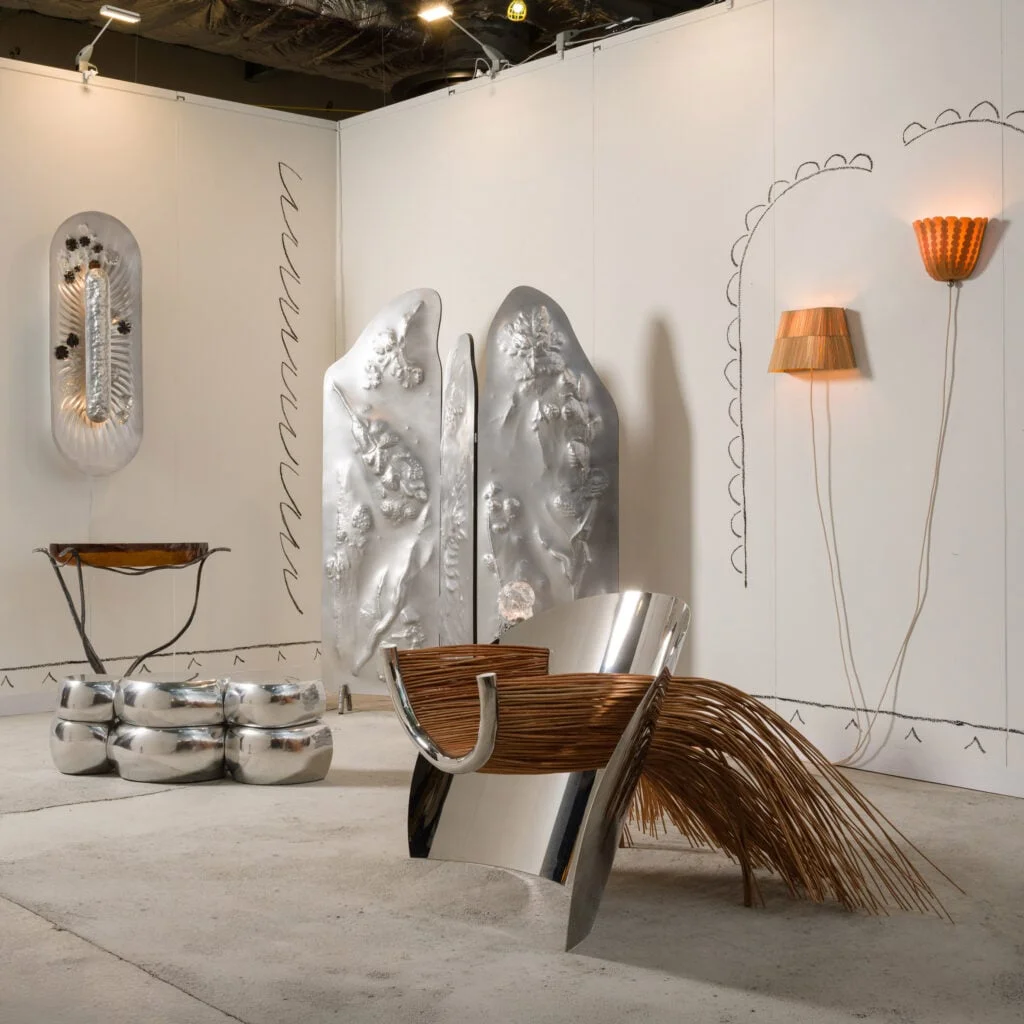
New York’s November design calendar is starting to look like a second annual market moment. Collectible furniture and independent showcases gave the fall lineup a clear identity, while BDNY remained the week’s main commercial draw. The format is still informal, but the concentration of fairs and exhibitions suggests it’s becoming a meaningful addition to the city’s design schedule.
The shift gained momentum after ICFF announced it would run alongside its sister fair, BDNY, in 2027. ICFF has long anchored NYCxDesign, whose festival remains set for May that year. That creates room for two different emphases: a spring gathering oriented toward industrial design, and a November programme with more attention on collectible furniture and gallery presentations.
A fall calendar with a distinct character
BDNY and Salon Art + Design have occupied November for years. More recent fairs and pop-up exhibitions are now clustering around them, making the period feel larger without a central organizer or a formal “design week” structure. NYCxDesign also tested a November presence this year, convening designers Ross Lovegrove, Karim Rashid and Rem D Koolhaas for a discussion moderated by New York-based design writer Camille Okhio.
The panel explored artificial intelligence and questioned the place of craft in design conversations. That debate sat alongside a visible appetite for handmade, singular objects across the showcases. The contrast gives the November programme some useful definition: the fairs can serve both a trade audience looking for products and a collector audience drawn to pieces with a strong material or authorial identity.
Collectible, the Brussels-founded fair, offered the clearest concentration of that collectible work. Its third New York edition moved from WSA, an office tower converted into a creative hub, to a disused Upper East Side cinema being developed by entities related to WSA. The raw venue suited the experimental work, though the build-out was uneven. Recently poured cement and other signs of an unfinished installation added to the disorder, and an exhibitor’s unstable light fell and injured a worker, who was taken to hospital.
Collectible described the incident as an “isolated occurrence involving an exhibitor’s equipment”. A representative said the fair takes reported incidents seriously, maintains safety procedures and expects exhibitors to secure their own installations. The episode was a reminder that temporary exhibition spaces can bring logistical demands that are easy to underestimate, particularly when venues are still being prepared.
Independent work and material detail
Despite the rough edges, several presentations made strong use of the fair’s setting. Philadelphia-based Dudd Haus kept its booth spare, letting conceptual one-off pieces carry the display. Jordan Maurice’s milled-aluminium floor lamp stood out, as did a paravent by Overt Cove made from telephone cords.
Two other booths leaned into a more sensual register. Upstate New York gallery Freaks showed drooping glass lamps and shades with erotic associations, while Iitem studio paired drapery with lacquered furniture. Across the fair, the presentation retained a polished, contemporary feel, with USM components appearing in the scenography. Curators Alex Tieghi-Walker and Lynette Nylander shaped special sections.
Relief and raised surfaces offered a quieter link between otherwise varied pieces. Polish studio Wiktoria & Filip Bielicki, presented by Objekt Gallery, showed a battened screen with a sculptural surface. At Salon 21, a Small Things Studio coffee table brought raised ceramic detail to its base. Both examples added texture to modern forms without overwhelming their function.
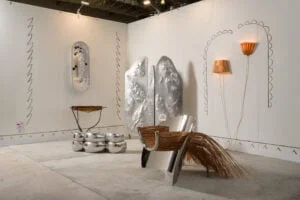
Montreal collective Ensemble used USM panels to create display niches for members’ work at Collectible, but the fair booth was only one part of its New York programme. At the Tribeca studio of Yabu Pushelberg, the collective built a plywood room inside the larger office. The focused presentation gathered new lamps by Zebulon Perron, sculptural glass lighting by Alex Joncas, metalwork by Jérémy Paguet, leather lamps by Jeta Studio and brass-lined mirrors by Jeremy Le Chatelier.
That installation made a case for tightly edited group shows. Rather than filling the room with objects, Ensemble used a clear architectural frame to give each maker’s work space and keep the collection legible.
Where galleries met the trade audience
At Salon Art + Design, younger galleries provided a counterpoint to the fair’s established historical material and high-end contemporary work. Brooklyn-based Zarolat presented ash-wood lamps with cellulose shades developed by Natural Urbano and Polybion. New York’s Bossa Furniture, a hub for Brazilian design, showed a selection of mid-century São Paulo makers that included Joaquim Tenreiro.
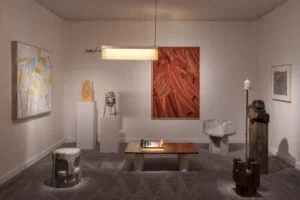
For purchasing activity, BDNY remained the week’s centre of gravity. Interior designers and architects came for a trade-oriented, sample-heavy show, where established brands presented collections aimed at specification and hospitality projects. Sancal showed playful armchairs by Júlia Esqué, while Santa & Cole presented modern lighting with a lighter tone.
The contrast between BDNY and the collectible fairs is useful for understanding the emerging calendar. One brings designers and architects into direct contact with commercial product; the others make space for limited production, gallery representation and more experimental work. The audiences may overlap, but the different formats give visitors distinct reasons to attend.
Satellite showcases broaden the offer
Basic Space returned to SoHo later in the week. The Los Angeles-based platform is run by the organizers behind Design Miami, and this edition used artistic direction by Alexander May. Its white-cube presentation differed from the multi-room, in-situ format used for its first New York edition in 2025. The emphasis on prominent names and multiple curatorial voices sometimes competed for attention, but individual works cut through.
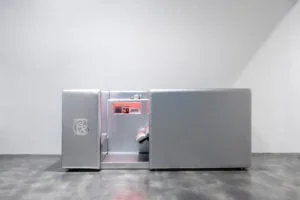
Brooklyn designer Gregory Beson showed live-edge wood furniture joined with small metal elements. Daniel Swarilov presented metal credenzas in a section curated by Marquel Williams. Paris-based Harry Nuriev built a standalone metallic installation based on first-class airline seating. A large sofa from Si Vis Pacem, the luxury furniture brand of NFL player Stefon Diggs, brought celebrity culture into the same room as collectible design.
Fábrica, a Mexico City creative studio run by artist Darryl Richardson and Maryah Ananda, took a different approach with its La Sala showcase in a loft near Penn Station. The presentation centred international Black designers and treated the venue as a living room, with interiors by Johnathan Bailey. A slim metal chair by Kai Avent-deLeo and an armchair by Mark Grattan were among the furniture on view.
La Sala’s social setting gave the work a distinct presence. Its stated principles, “community over curation” and “warmth over spectacle”, described a gathering built around connection as much as display. That approach widened the week’s range beyond fairs, booths and formal galleries.
The November programme still lacks the coordination and settled identity of a mature citywide event. Yet the mix is already taking shape: BDNY anchors trade activity, Salon Art + Design brings galleries and established collections, and newer showcases make room for independent makers and alternative formats. With ICFF scheduled alongside BDNY in 2027, New York’s fall design calendar looks set to gain a stronger commercial spine while keeping its collectible and experimental edge.
Discussion
Sign in to join the discussion.