A proposed cultural artefact storehouse in Brent encapsulates innovative student designs exploring community and environmental relationships in London.
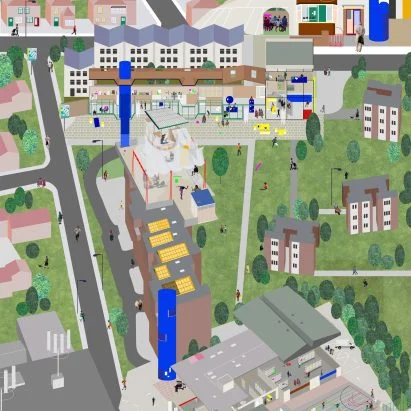
Among the intriguing student projects emerging from the London School of Architecture (LSA) is a forward-thinking proposal for a cultural artefact storehouse located in Brent, UK. This ambitious concept serves as a testament to the vibrant tapestry of cultural production and reflection within suburban contexts.
Student Projects Addressing Real-World Challenges
The works presented by LSA's latest cohort reflect a deep engagement with pressing contemporary issues. Each project not only tackles architectural design but also offers broader social insights, particularly concerning community, ecology, and urban living. The show, themed “If Only We Will,” draws inspiration from the historical County of London Plan, focusing on how these modern interpretations respond to today’s complexities.
A Storehouse for Cultural Artefacts
The project titled “New Imaginaries of Resistance in the Suburban Ends” by student Anu Sofuyi envisions a dynamic storehouse aimed at capturing the essence of diasporic activities. Rather than merely a shelter for objects, this storehouse seeks to create an adaptive space that highlights the narratives woven into the fabric of the community. This reflection on cultural production pushes boundaries by developing a model for continuous engagement with the locality.
Integrating Care in Urban Housing
Another notable project comes from William Brooks, whose work emphasizes the needs of care leavers through the concept of a supported housing community named Hollybush Yard, situated in Bethnal Green. Here, Brooks incorporates co-living spaces that foster learning and independence among young residents, embedding support systems that facilitate their transitions into adult life.
Reimagining the Relationship with Urban Nature
Elen Togher takes a bold stance in her project addressing ecological concerns through the lens of river rights. Positioned along the River Lea, the proposal suggests empowering rivers as rights-bearing entities. This conceptual shift could drive significant changes in urban design, promoting sustainable practices by integrating a reed filtration network and spaces for river recreation, all framed within a healing landscape.
Redefining Urban Identity
Thomas Simms’ “Maker Commons” embraces Hackney Wick and Fish Island’s industrial heritage. This initiative critiques the ongoing displacement of creative industries by advocating for restored infrastructures that celebrate making and craftsmanship. The design aims to challenge investor-driven approaches, instead proposing that architectural spaces can help rejuvenate community fabric and foster local economies.
Climate Resilience and Infrastructure
With an eye on future challenges, Josie Tindale explores how integrating flood-resilient infrastructure along the Thames can harness the river’s historical significance while securing the city against climate threats. “Time and Tide” emphasizes archaeological heritage as part of environmental recovery, suggesting methods to enhance biodiversity through innovative public space design.
Community-led Urban Regeneration
Rachel Opie challenges conventional regeneration tactics with her thesis on “Feeding Kilburn,” advocating for adaptive reuse and deconstruction strategies that encourage community-led infrastructure before demolition. By redefining the methodology of regeneration, Opie’s project illustrates how sustainable urban strategies can stem from existing resources, thus reinforcing community presence in rapidly changing urban landscapes.
Educational Environment Transformation
The need for adaptable educational spaces is articulated in Gloria Hii’s “Ephemeral Boundaries.” This project calls for a transformation of schools into more porous environments conducive to well-being and creativity, moving beyond traditional constructs that limit sensory engagement in educational settings.
Rethinking Urban Expansion
Caspar Barker presents a critique of planning policies targeting greenbelt lands amidst London’s burgeoning population. His thesis suggests that suburban neighborhoods can strategically develop mutually beneficial models to counter sprawl, paving the way for sustainable housing practices without sacrificing precious green spaces.
Advocating for Mental Health in Architecture
Sam Wimbush addresses a critical question: how architecture can fundamentally enhance mental health support? Instead of isolating services within large, sterile institutions, Wimbush proposes a network of accessible community spaces where mental health care is integrated into everyday environments, leading to more proactive and inviting support systems.
A Vision for a Collective Future
The collective output of this year’s cohort at the London School of Architecture highlights a shared ambition to create spaces that are not merely buildings but catalysts for community and cultural engagement. This year’s show marks a pivotal moment in architectural education, reflecting a commitment to meaningful change in urban contexts. Through these imaginative designs, the future of London’s architecture appears promising—centered on inclusivity, resilience, and communal well-being.
As these students enter the professional world, their work stands as a powerful reminder of architecture's role in shaping lives, advocating for environmental stewardship, and redefining urban interactions in a complex world.
Discussion
Sign in to join the discussion.