The U.S. housing market reveals a K-shaped trend, with a flourishing luxury sector contrasting a struggling entry-level market, according to Realtor.com's latest report.
Current State of the U.S. Housing Market
The latest report from Realtor.com illustrates a distinct “K-shaped” housing market in the United States. This phenomenon manifests as the luxury housing sector experiences significant growth while entry-level housing struggles to gain traction. The term “K-shaped” is particularly revealing—it tells us that the housing market isn't just fluctuating but is separating along income lines, creating a scenario where those at the top of the income bracket are thriving, while those at the bottom are increasingly disenfranchised.
Trends in Entry-Level Housing
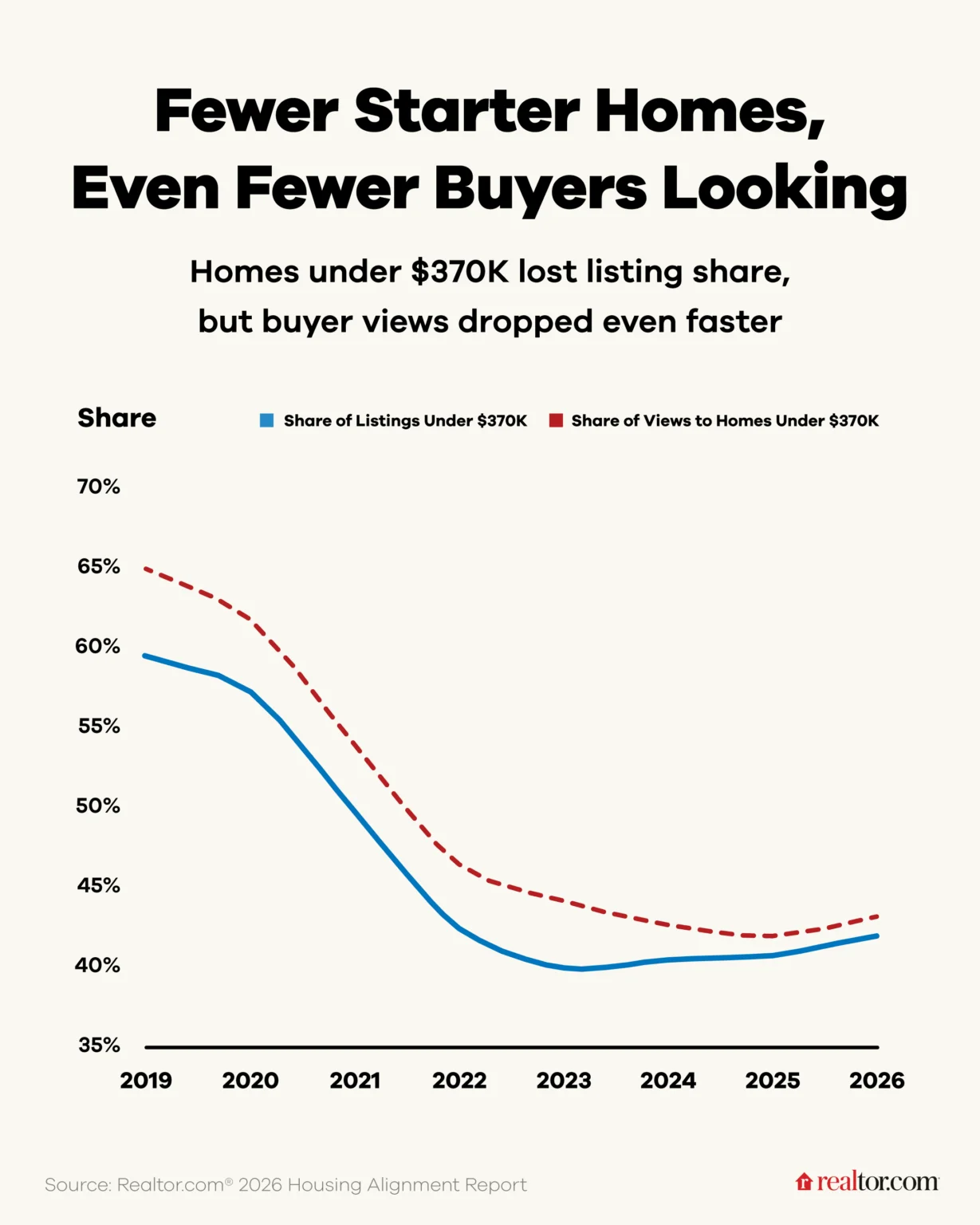
Interest in homes priced at $370,000 and below has sharply decreased, plummeting by 11.4 percentage points to 42.8% between 2021 and 2026. In 2021, these properties constituted nearly half of all listings and garnered over half of online traffic. This dramatic decline suggests profound shifts in buyer sentiment and market conditions, underlined by rising interest rates and stagnant wages that are squeezing potential buyers' financial capabilities. As buying power weakens for many, a clear shift toward more expensive options has emerged, leaving lower-priced homes floundering, further exacerbating housing inequality.
Senior Economist Jiyai Xu emphasized that, “In a typical supply-constrained entry-level market, fewer homes for sale would intensify competition for each listing. Instead, engagement with lower-priced homes has fallen to its lowest level since 2019." The contrast here is startling; despite a supposed scarcity of homes for entry-level buyers, interest is absent. This decline suggests that potential buyers who would historically compete for these houses are now opting out of the market entirely. It's a stark reminder of how economic factors can fundamentally shift buyer priorities, forcing people to reconsider what a first home might look like.
The Luxury Market's Robust Performance
The stark contrast between luxury property demand and entry-level stagnation highlights the K-shaped dynamic. While the median list price for homes in July was reported at $428,950—down 2.4% year-over-year—the median sales price remained stable at $425,000. This discrepancy indicates that while luxury properties are still finding their buyers, the broader market is experiencing a disconnect that complicates understanding trends. Notably, in 2022, the median price of homes viewed online was $30,000 less than the median listing price, revealing the growing gap between what buyers desire and what’s available. People aren’t just looking for homes in their budget—they’re seeking value.
As demand for luxury homes remains resilient, the disparity between market segments continues to widen. Luxury buyers are increasingly looking at homes that far exceed the median list prices, leading to a market further stratified by affordability. This affluent segment of the market doesn't just persist; it thrives, benefiting from economic conditions that place them in a position of power while the average buyer struggles. An elite circle is effectively emerging within the housing market, creating a barrier for entry that complicates the path to homeownership for the average American.
Looking Ahead
Realtor.com summarized the situation by stating, “The change is not a return to a broadly accessible market; it’s a more stratified one.” This distinction highlights an enduring housing shortage that disproportionately affects lower-priced homes, indicating that while the market may appear balanced, it is inherently skewed by the retreat of price-sensitive shoppers. You can even say it's more significant than it looks. In many cases, households earning modest wages are finding themselves increasingly sidelined, with fewer options and lower competition amid rising prices.
As we navigate the uneven terrain of the housing market, it’s clear that understanding the diverging paths of entry-level versus luxury demand will be essential for industry professionals. If you're working in this space, you’ll need to consider how emerging economic factors—the job market, inflation, and the trend toward remote work—all contribute to shaping these distinct segments. The current bifurcation is indicative of broader economic trends; while the affluent prosper, the average homebuyer grapples with ever-tightening constraints.
Implications for Future Market Dynamics
The repercussions of this bifurcated market structure are profound. Not only do they reflect existing economic divides, but they also have the potential to shape future urban development and housing policy. As luxury developers capitalize on their success, there's little incentive to cater to the entry-level market, which risks further deepening a divide that’s already quite pronounced. And yet, the ongoing trend of high rental prices and decreasing availability of affordable homes could serve as a wake-up call for policymakers who must now grapple with these striking imbalances.
What this means for you as a real estate professional is a need to rethink strategies. Conventional wisdom may no longer apply when advising clients both buying and selling. Understanding market dynamics at play in each segment will become more critical than ever. Will there be a resurgence in entry-level interest? Time will tell, but the current indicators suggest a complicated road ahead, marked by a lingering lack of affordable housing combined with soaring demand for luxury options. These factors will invariably shape market behavior for years to come.
Discussion
Sign in to join the discussion.